Fly Ash and Slag Are Running Short. Calcined Clay Goes Commercial. Where Does Anorthosite Fit?
Boris Hardi
Author
EU supply of fly ash and slag is set to fall sharply by 2035. In October 2026, calcined clay moved into certified commercial supply. What that means for anorthosite-based binders and by-products.
The cheapest way to cut CO2 in cement has been to use less clinker and more supplementary cementitious materials (SCMs). For decades, the two main SCMs were by-products of other industries: fly ash from coal power and granulated blast furnace slag from steel. Both industries are now changing, and the supply of both materials is shrinking with them.
What the supply numbers show
A 2025 scenario study in Developments in the Built Environment modelled SCM supply in the EU from 2023 to 2050. Its results:
- Fly ash falls from 8.5 Mt in 2025 to 1.9 to 2.7 Mt in 2035, and to 0 to 1.1 Mt in 2045.
- Granulated blast furnace slag falls from 18 to 19 Mt in 2025 to 6.9 to 11.4 Mt in 2035, and to 0 to 3.2 Mt in 2045.
The authors conclude that conventional SCMs will not meet demand even if demand for ordinary Portland cement falls significantly. They call for work on the production and logistics of alternatives to keep clinker ratios low. The study puts cement at about 8% of global greenhouse gas emissions.
The reasons are structural. Coal plants are closing, and steelmakers are moving from blast furnaces to electric arc furnaces and direct reduced iron, which produce no blast furnace slag.
Calcined clay moves from trials to contracts
The most visible response in October 2026 was calcined clay.
United Kingdom. CemBlend and Hepworth Clay launched HepCem at the Precast and Masonry Expo on 22 October. It is made from selected clay at Hepworth's Crow Edge site near Sheffield and is certified by Construction Products Certification to BS 8615-1:2019+A1:2026 as a pozzolana for use with Portland cement. According to Concrete Connect:
- Typical replacement is 20 to 35% of Portland cement. Hepworth's guidance gives 6 to 20% for CEM II/A-Q and 21 to 35% for CEM II/B-Q.
- The 28-day strength activity index is 80% (BS EN 196-1).
- Hepworth publishes a preliminary cradle-to-gate figure of about 200 kg CO2e per tonne (modules A1 to A3) from trial production. It says this is not yet a verified environmental product declaration.
Australia. Green360 Technologies signed its first binding supply agreement with Holcim Australia for its calcined clay product MKX-CC: up to 4,800 tonnes over an initial 12 months for Holcim's concrete operations in Victoria, Global Cement reported. Calcination capacity comes through an agreement with Calix. Executive chair Aaron Banks described the market as one "facing structural shortages of fly ash and blast furnace slag".
These volumes are small next to national cement markets. But both cases show the same steps: a certified product, an industrial calciner, and a named buyer.
Where anorthosite fits, and where it does not yet
Anorthosite, a calcium-rich feldspar rock found in large homogeneous bodies in Greenland, appears in the cement debate on three separate tracks. It is worth keeping them apart.
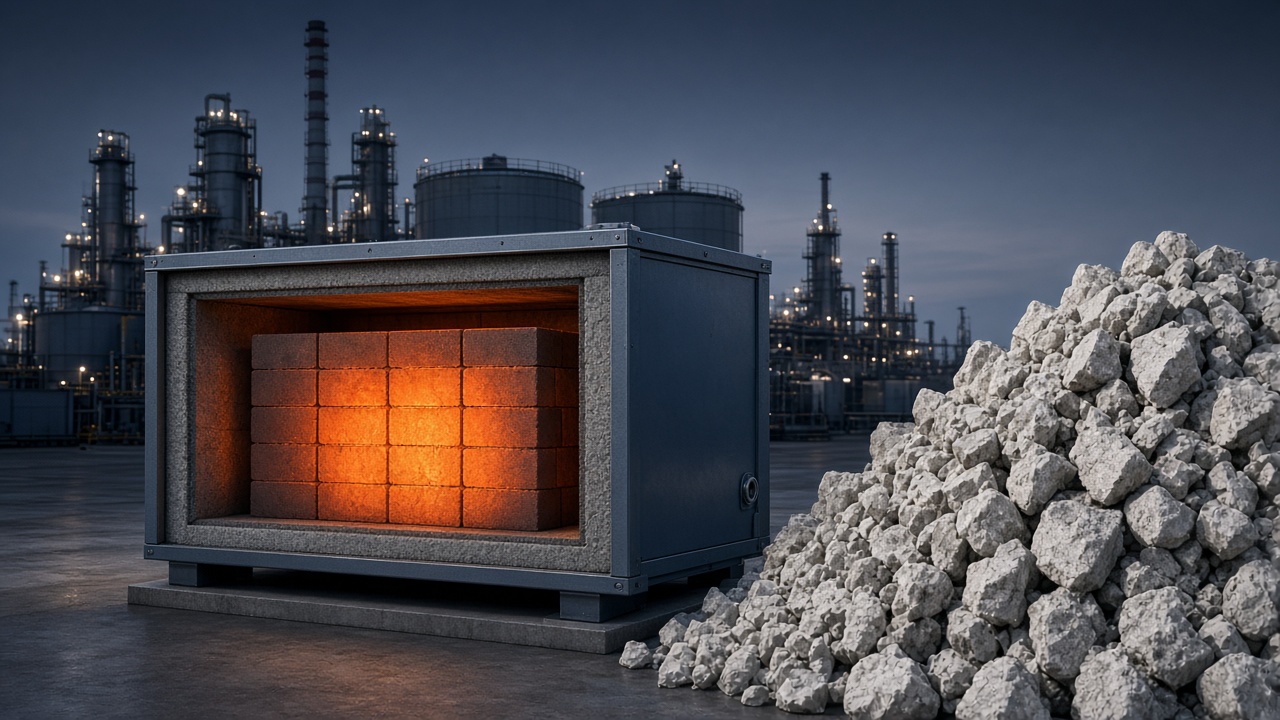
- As a clinker-free binder. In 2025, the Danish Technological Institute (DTI) tested a phosphoric-acid-bonded binder made from 100% Greenland anorthosite for AnorTech. Refractory prisms withstood repeated heating at 1,200 °C. We covered those results in an earlier post.
- As an alkali-activated, cement-free concrete. In October 2026, DTI reported 3D-printing tests of cement-free, alkali-activated anorthosite concrete with the robotics company ERLEtek, supported through the ESA Business Incubation Centre. The focus is building on the Moon. DTI notes that cement-free concrete could also cut construction CO2 on Earth and calls the results early.
- As by-products of alumina refining. Greenland Mines describes AnorTech's patent-pending alumina process as producing saleable amorphous silica and calcium silicate by-products, without bauxite residue. The flowsheet has been demonstrated at laboratory scale, and 15 tonnes of anorthosite have been shipped to Ontario for pilot testing.
What is missing is the step calcined clay has now taken. We have not seen a product standard, a certification, a verified environmental product declaration, or a named cement or concrete buyer for any anorthosite-based binder or by-product. Whether the silica and calcium silicate streams can be used as SCMs, and at which replacement levels, has not been published.
What to watch
- Independent reactivity and strength data for AnorTech's silica and calcium silicate by-products, once pilot material exists.
- Certification steps and the one-year weathering results for the refractory binder.
- Verified environmental product declarations for HepCem and other calcined clays once steady production starts.
- Further offtake deals that put tonnes and buyers on paper.
Disclosure: ZeroWasteMetals is an independent information project run by an investor in AnorTech and Greenland Mines. Not affiliated with either company. Not investment advice.
Sources
- Developments in the Built Environment: Concrete change, future scenarios for SCM supply in the EU (2025)
- Concrete Connect: UK calcined clay enters commercial supply (23 Oct 2026)
- Global Cement: CemBlend and Hepworth Clay launch calcined clay product in the UK (22 Oct 2026)
- New Civil Engineer: Reduced carbon footprint calcined clay cement to be launched (20 Oct 2026)
- Global Cement: Green360 Technologies signs agreement with Holcim for low-carbon cement product
- AnorTech: Positive Results From Sustainable Cement R&D Program (4 Jun 2025)
- DTI (Byggeri & Anlæg – Teknologisk Institut): Concrete construction on the Moon with anorthosite (22 Oct 2026)
- Greenland Mines: Doubles AnorTech stake to 19.9% (5 Oct 2026)